
ERASMUS MUNDUS JOINT MASTER
Calling future urban thinkers who are curious and interested in how we can revitalise post-industrial cities to join a European Master of Science developed by 8 prestigious universities within the scope of UNIC. A comprehensive 2 year study programme with 120 ECTS, fully delivered in English and with tailored mandatory mobility between the participating university campuses.
RUHR UNIVERSITÄT BOCHUM - UNIVERSITY COLLEGE CORK - UNIVERSIDAD DE DEUSTO - ERASMUS UNIVERSITEIT ROTTERDAM - KOÇ UNIVERSITY - UNIVERSITÉ DE LIÈGE - UNIVERSITY OF OULU - UNIVERSITY OF ZAGREB
OVERVIEW
ABOUT THE REPIC MASTER’S
This exciting and unique new Erasmus Mundus Joint Master (part of the UNIC alliance), wants to create an educational experience which recognizes and responds critically to issues of cities in different forms and stages of post-industrial transition. It aims to educate the next generation of specialists with the 21st century skills and knowledge needed to address the challenges and opportunities of cities in transition and superdiverse societies.
This is an inter-university, multidisciplinary joint postgraduate programme, that uses the ECTS credit system to facilitate the recognition of qualifications. It also actively defines mobility periods for students between each of the partner universities.
Building on the complementary strengths of the vibrant UNIC partnership and involving a broad range of associated partners from government, industry, and the public, RePIC offers unique perspectives on the post-industrial city. It also provides a potentially life-changing physical and virtual student mobility experience.
It is the ideal programme for professionals involved in the design, planning, management or evaluation of the city who want to join a vibrant knowledge and innovation community committed to the rethinking of more sustainable urban futures.
Further information about the RePIC Curriculum, the mobilities as well as mutual rights and obligations between the Parties can be found in the Erasmus Mundus Joint Master Redesigning the Post-Industrial City Student Agreement.
DURATION
2 years (4 semesters)
QUALIFICATION
MSc (Master of Science)
LANGUAGE OF INSTRUCTION
English
TEACHING MODE
On-campus and full-time (some modules/courses will be offered online)
SCHOLARSHIPS
Erasmus Mundus Scholarships available on a competitive basis for admitted students
APPLICATION PERIOD
EU/EFTA and Non-EU/Non-EFTA
OPEN: 01 NOV 2026
CLOSE: 28 FEB 2027
TUITION FEES
Citizens from EU, Iceland, Norway, North Macedonia, Liechtenstein, Serbia, Turkey
Full programme/course tuition fee: €9,000
Per semester: €2,250
Other Citizens
Full programme/course tuition fee: €18,000
Per semester: €4,500
LOCATION
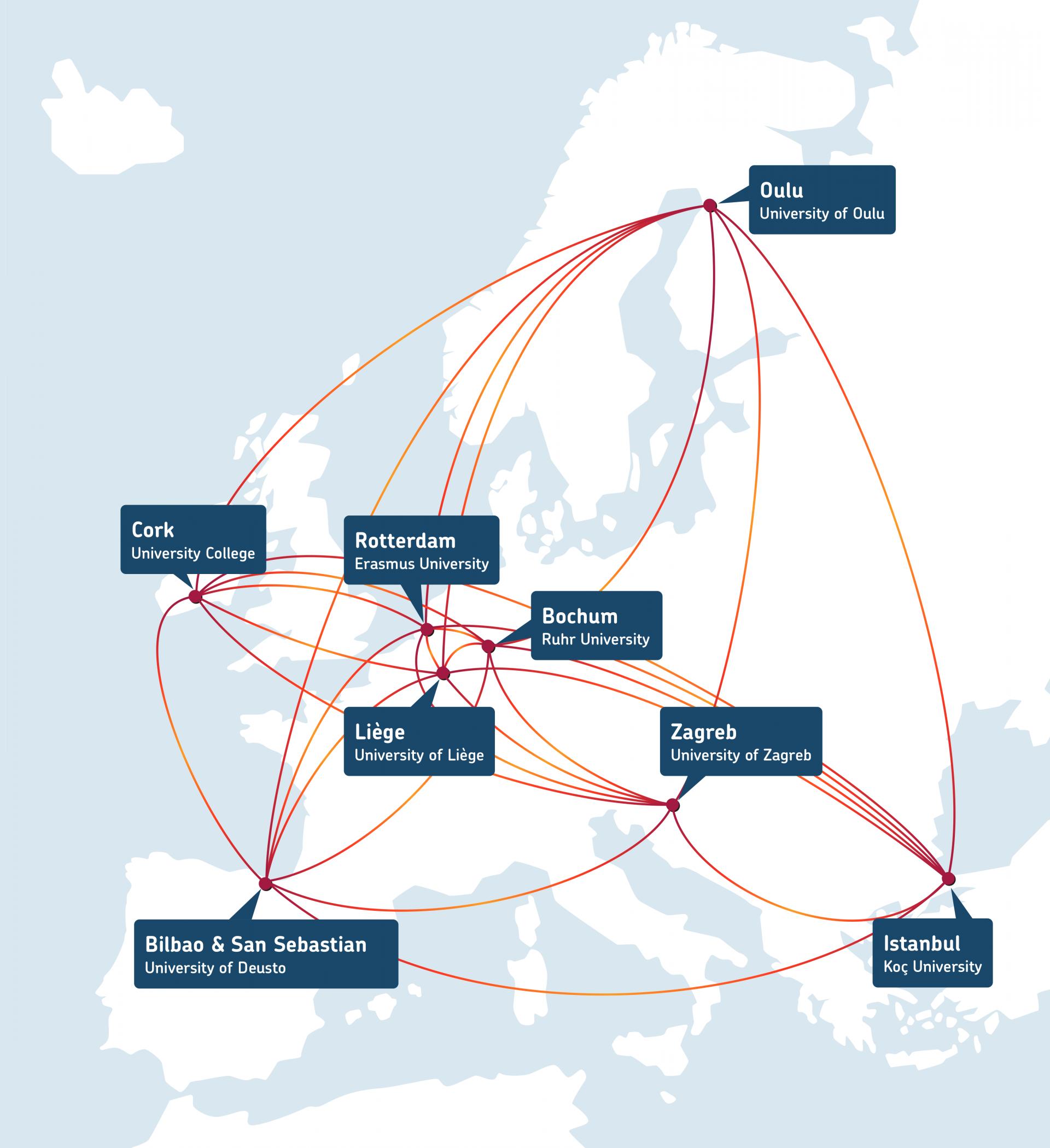
UNIC RePIC partner universities in 8 cities across Europe (Bochum, Cork, Rotterdam, Istanbul, Liège, Oulu, Zagreb, Bilbao)
ACCREDITATION
Accredited by AQAS (Agentur für Qualitätssicherung durch Akkreditierung von Studiengängen e.V., Germany)
Fully compliant with the Standards and Guidelines for Quality Assurance in the European Higher Education Area (ESG) and the European Qualifications Framework (EQF)
Registered in the European database of accredited programmes DEQAR
VISION
RePIC’s vision is to cultivate a dynamic, international network of urban thinkers capable of shaping future-oriented, critical, and innovative approaches to the revitalisation of the post-industrial city. The programme positions cities as complex socio-spatial systems and prepares graduates to engage creatively and responsibly with the economic, environmental, cultural, and technological transformations shaping urban life.
RePIC graduates possess advanced research, professional, digital design, and spatial analysis skills, enabling them to mediate between experts and laypersons, academia and society, policy and practice. With broad and integrative knowledge across the field’s sub-disciplines, they are equipped to operate as translators, facilitators, and change-makers within interdisciplinary and international urban contexts.